

TL;DR — Quick Answer
You can prep a D&D session in about 15 minutes if your campaign has searchable memory. The workflow: open last session's recap (the recap is your prep sheet), scan open quests and unresolved threads, check the NPCs, loot, and promises the party collected, prep only what you can't improvise, and drop your prep notes where you'll actually run the session. With Tavern Scribe, the recap, quest log, and character records are generated from your session recording and searchable at prep time — so prep starts from what actually happened, not from an hour of digging through old notes.
Want the tool rather than the workflow? See the D&D session prep tool with AI campaign memory built for exactly this loop. This post is the workflow itself.
Why prep takes two hours (hint: it isn't the prep)
Most long prep nights aren't spent building encounters. They're spent reconstructing — scrolling old docs and Discord to figure out which quests are live, which NPC the rogue threatened, and what the party swore to do next. We wrote about that failure mode in the most exhausting part of session prep isn't the prep, and the short version is: the review phase, not the creative phase, is what eats your evening.
This guide assumes you've fixed the review phase — your campaign has memory you can search instead of notes you have to excavate. Here's the 15-minute loop that falls out of that.
Step 1 — Open last session's recap (minutes 0–3)
Don't start from a blank page. Start from the recap of last session — the recap is the prep sheet.
If you process your sessions with Tavern Scribe, this document already exists: upload the session's audio or video and the AI generates a written recap plus a chronological event timeline of the whole night. (The AI D&D session recap page shows what one looks like.) Read it once, slowly. You're looking for three things:
- Where the session ended — the literal last scene, because that's your cold open.
- What the party said they'd do next — their stated plan is your prep target.
- Anything you promised — the vision you teased, the letter that was "on its way."
Three minutes, and you know what next session is actually about.
Step 2 — Scan open quests and unresolved threads (minutes 3–6)
Next, the quest log. Not to admire it — to triage it. Tavern Scribe tracks quests as active, available, and completed, with objectives and rewards on each, so this scan is a glance down a list instead of a memory test.
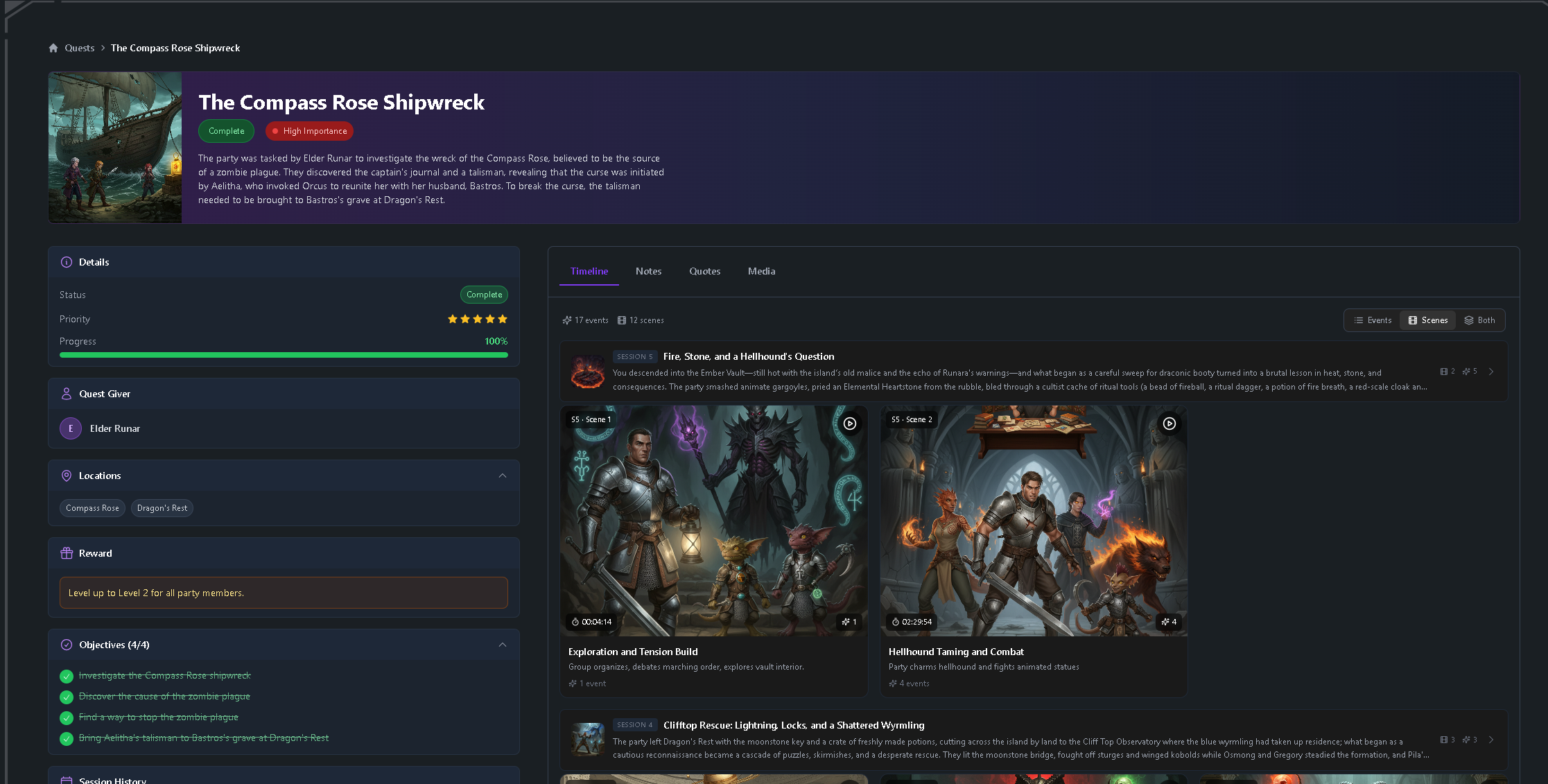
Ask two questions of every open quest:
- Can the party touch this quest next session? If yes, it needs a next beat prepped — one scene, one clue, or one complication.
- Is a thread about to go stale? A quest nobody has mentioned in three sessions either needs a nudge (a messenger, a rumor, a consequence) or an honest retirement.
Unresolved threads that never made it into a formal quest live here too: the strange door nobody opened, the cult symbol nobody researched. Pick at most one to surface next session. Restraint is prep too.
Step 3 — Check who and what the party met (minutes 6–9)
Now the people and the stuff. This is the step that used to be pure archaeology: did the party leave that merchant alive? What did the hag actually promise? Who's holding the cursed dagger?
With campaign memory it's a lookup, not a séance:
- NPCs — character records track PCs, NPCs, and fallen characters with portraits, bios, and their campaign history, and relationship tracking shows how the party stands with each of them. Check anyone likely to appear next session; note one want and one fear for each.
- Loot — inventory tracking covers items, quantity, and value across the whole party, so you know exactly who is carrying the macguffin before you build a scene around it.
- Promises — search the campaign for the deal, oath, or debt you half-remember. If a payment comes due next session, that's a free scene you didn't have to invent.
If you're not sure a thing happened at all, ask the campaign Q&A — it answers from your prior sessions, not from vibes.
Step 4 — Prep only what you can't improvise (minutes 9–13)
Everything so far was reading. Now you write — but only the things you genuinely can't make up at the table. For most DMs that's:
- One or two strong scene openers — a first line of description or dialogue for the session's likely big scenes.
- Combat numbers — stat blocks, HP pools, and the one battlemap you expect to need. Rulings and flavor you can improvise; math mid-fight is misery.
- A secret or a reveal — the one piece of information that moves the story, and who knows it.
- Names — five spare NPC names, because "uh… Greg?" haunts campaigns forever.
Everything else — tavern chatter, minor NPC reactions, travel color — improvises better than it preps. This is the same philosophy behind Sly Flourish's Lazy Dungeon Master approach: prepare what helps you improvise, skip what replaces it. Campaign memory just makes the lazy approach safe, because the facts you'd otherwise misremember are one search away during play.
Step 5 — Drop your prep notes where you'll run the session (minutes 13–15)
Prep that lives in a separate app dies in that app. Spend the last two minutes putting your notes where game night actually happens.
In Tavern Scribe, that's the same workspace as the table: collaborative notes sit beside the maps, tokens, initiative, and fog of war of the free virtual tabletop, so your scene openers and stat notes are one panel away while the party is on the map. Load the battlemap you picked in step 4 now, too — future-you, mid-session, will be grateful.
Done. Fifteen minutes, and the creative part was two-thirds of it.
The 15-minute prep checklist
Steal this list. Run it top to bottom before every session:
- Re-read last session's recap; note where it ended and the party's stated plan.
- Write the cold open — one sentence picking up from the final scene.
- Triage open quests: give every touchable quest one prepped next beat.
- Nudge or retire one stale thread.
- Review NPCs likely to appear: one want, one fear each.
- Confirm who's carrying the important loot.
- Check promises and debts coming due.
- Prep combat numbers and one battlemap.
- Write one secret or reveal, and who knows it.
- List five spare NPC names.
- Put all of it in the workspace where you'll run the session.
How campaign memory changes the loop
Notice what this workflow never asks you to do: remember things. Every step is a read or a search against records that already exist, because they were extracted from what actually happened at the table.
That's the structural difference campaign memory makes. Tavern Scribe processes your session recording — the virtual tabletop can record right where you play, and the Tavern Scribe Discord bot records your voice channel for Discord tables — into a recap, an event timeline, and updated quest, character, and inventory records. All of it is searchable: events, characters, locations, quests, the whole campaign history.
And when memory and the table disagree, you don't argue — every extracted event links to the exact timestamp in the recording where it happened. "What did the wizard actually promise the hag?" stops being a twenty-minute debate and becomes a ten-second clip.
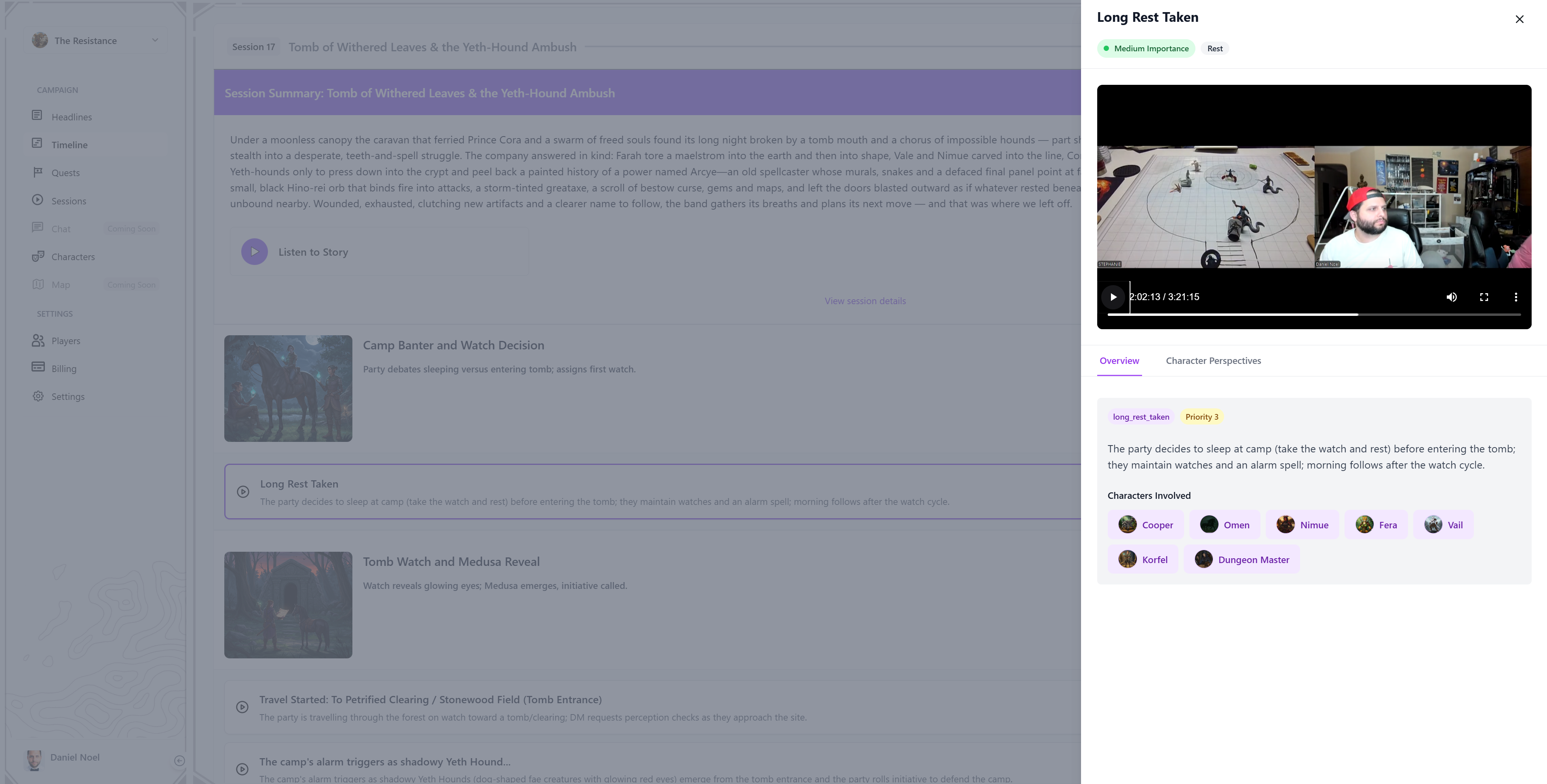
The loop compounds, too. Each processed session updates the same quest log, the same NPC records, the same inventory — so session 30 preps in the same 15 minutes as session 3, instead of slower every week as the pile of old notes grows.
FAQ
How long should D&D session prep take?
For an ongoing campaign, about 15 minutes of core prep is realistic once the review phase is solved: read the recap, triage quests, check NPCs and loot, then prep only unimprovisable material like combat numbers and key reveals. DMs who spend 1–2 hours are usually spending most of it reconstructing what already happened, not creating what happens next.
What should I prepare before a D&D session?
A cold open that picks up from last session's ending, one next beat for each quest the party can touch, notes on likely NPCs (a want and a fear each), combat stat blocks and a battlemap, one secret or reveal, and a handful of spare names. Skip anything you can improvise at the table — most flavor and minor NPC reactions improvise better than they prep.
Do I have to record my sessions to use this workflow?
No. The workflow works with hand-written recaps and a manually kept quest log, and Tavern Scribe's core campaign workspace — notes, quests, characters, maps — is free without any AI. Recording is what makes the memory automatic: upload session audio or video and the recap, timeline, and record updates are generated for you. AI processing runs on silver, and your first campaign starts with 100 free silver, so you can try it on a real session for free.
Does this work for Pathfinder and other TTRPG systems?
Yes. Campaign memory is system-agnostic — Tavern Scribe works for D&D, Pathfinder, and homebrew tabletop RPG campaigns alike, because it's built on what your table said and did, not on any one ruleset.
Try it on your next prep night
Run the checklist above before Saturday's session, even with the notes you have today — the workflow alone will save you time. Then, if you want the memory layer that makes it effortless, create a free campaign, record your next session where you already play, and let the recap be waiting when you sit down to prep.
Fifteen minutes later, you're done — and all of it was the fun part.
Tags: Session Prep, Dungeon Master Tips, Campaign Memory, Session Recap, Campaign Management
