

Somewhere around session 10, every D&D campaign hits the same wall: a player asks "wait, who was the guy who sold us the map?" and the table spends ten minutes arguing about a name nobody wrote down. Tracking a D&D campaign doesn't require a second job — it requires knowing what's worth writing down, picking a system your table will actually keep up with, and letting go of everything else. This guide covers exactly that: the five things that need tracking, the things that genuinely don't, three honest ways to do the tracking, and a starter structure you can copy into any tool tonight.
What actually needs tracking (and what doesn't)
The failure mode of campaign tracking is almost never "we didn't track enough." It's "we tried to track everything, burned out by session 6, and then tracked nothing." So start from the smallest set of records that keeps a campaign coherent:
1. Sessions — what happened. Not a transcript. Five to ten bullets per session: where the party went, what changed, what's unresolved. This is the spine everything else hangs off.
2. NPCs. Name, one line of who they are, one line of how the party left things with them. The NPC the party met for ninety seconds in session 4 will return as a quest-giver in session 14, and someone needs to remember that the barbarian insulted his hat.
3. Quests and threads. What the party has agreed to do, what they've heard about but ignored, and what they've finished. Three lists. The "ignored" list is secretly the most valuable one — it's your future plot fuel.
4. Loot and resources. Who is carrying the important items, and what the party owes or is owed. Not every copper piece — the items and debts that will matter in a future scene.
5. Decisions and consequences. The party spared the cult leader. The party burned the bridge. One line each. When consequences arrive three sessions later, this list is what makes your world feel like it remembers.
And here's what doesn't need tracking, no matter how guilty it makes you feel: verbatim dialogue, initiative-by-initiative combat logs, rules debates, worldbuilding the players never touched, and anything you can look up again in the book. If a note doesn't help you run a future session or help a player remember the story, it's a diary entry, not a campaign record.
Three ways to track a campaign, honestly compared
There are really only three approaches, and each one trades effort for structure differently.
The notebook (or a shared Google Doc)
The baseline, and genuinely fine for short campaigns. One doc, newest session on top, bullets only. It costs nothing, needs no setup, and works offline at a physical table.
The honest problems show up with length. Nothing links to anything, so finding "that ferryman NPC" at session 20 means scrolling and praying. There's one author, so when the notetaker misses a night, the record has a hole in it. And the notes are only as good as the fifteen minutes someone spends writing them while the session is still fresh — which is exactly the fifteen minutes everyone wants to spend saying goodbye and going to bed.
The dedicated campaign wiki
The step up is a purpose-built wiki, and the good ones are genuinely good. Kanka is built around not losing track of a single detail, with entity types for characters, locations, organizations, timelines, and calendars, cross-linked by mentions, and a free tier that allows unlimited entries. World Anvil is a worldbuilding platform and RPG campaign manager aimed at both authors and Game Masters, with campaign tools spanning well over a hundred RPG systems. LegendKeeper is a fast, collaborative worldbuilding wiki with interactive maps and whiteboards — and it's explicit about having no generative AI features, which some tables count as a selling point.
If your table has a lore-lover who enjoys writing entries the way some people enjoy painting miniatures, a wiki is a great home for a campaign. The honest catch is the same for all of them: everything in the wiki exists because a human typed it. The wiki is a beautiful, empty shelf, and someone — almost always the GM — has to spend post-session time filling it. Wikis don't decay because the software fails; they decay because session 13 ends at 11pm and nobody types anything.
Automatic tracking from session recordings
The third approach removes the typing. Instead of reconstructing the session from memory, you record the session — something many tables already do — and let the tooling build the record from the recording.
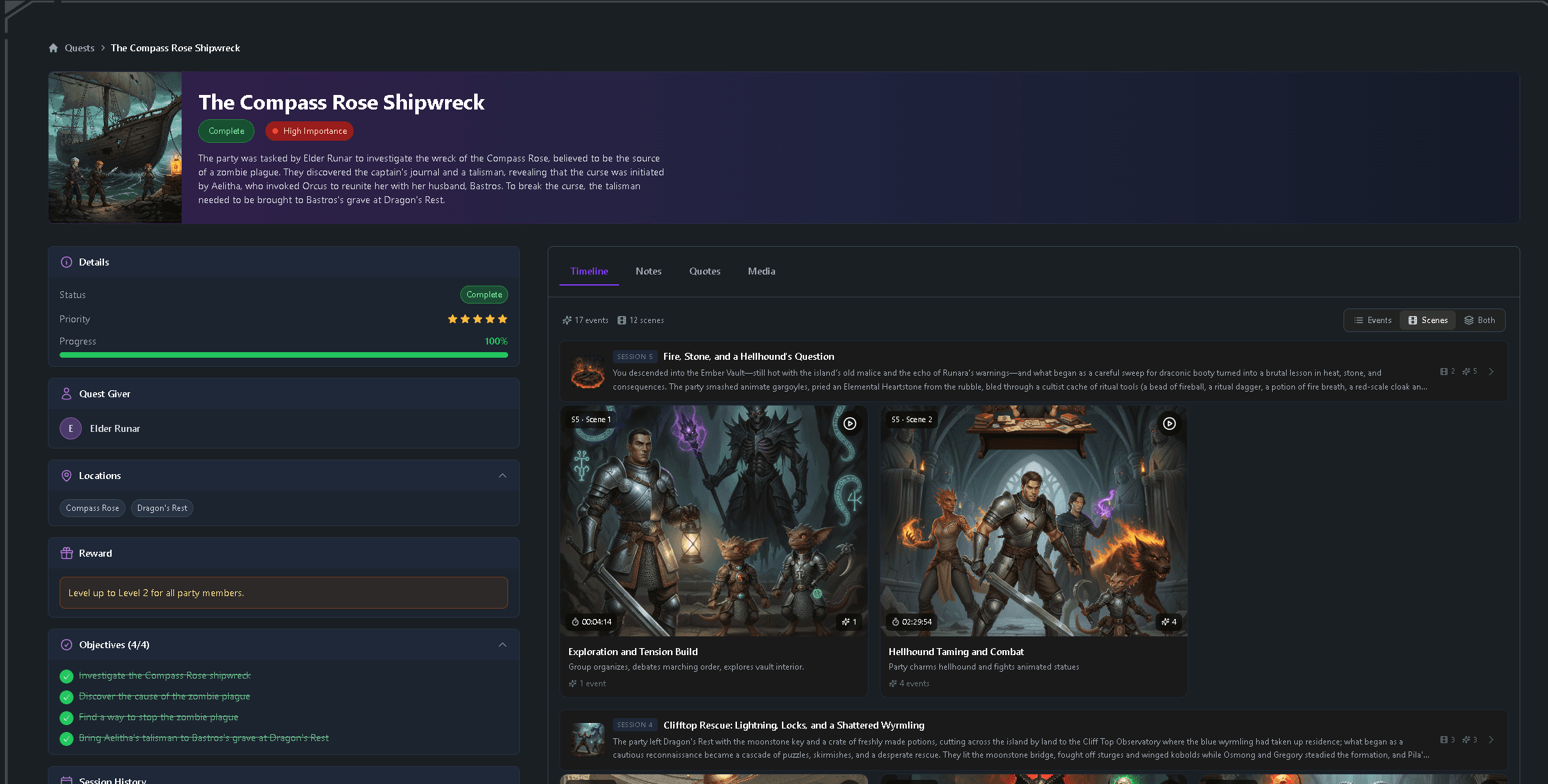
This is the approach we build at Tavern Scribe, so judge accordingly, but the mechanics are straightforward: a TTRPG campaign tracker that fills itself in from your sessions. Play on the built-in free virtual tabletop and record right where you play, let the Tavern Scribe Discord bot record your voice channel if that's where your table lives, or upload audio or video from a phone at an in-person table. Processing turns the recording into a written session recap, a chronological event timeline, and updates to the campaign records themselves — characters, NPCs, quests, locations, relationships, inventory, and dice rolls — each linked to the exact timestamp in the recording where it happened. "Who sold us the map?" becomes a search, and the answer includes a jump back to the actual moment.
The honest trade-offs: it assumes you're comfortable recording your table (always ask everyone), and while the core tracker and tabletop are free, the AI processing itself is metered after your first campaign's free allowance. If your table never records and loves writing lore by hand, a wiki will fit you better. Manual entry still works everywhere — automatic tracking is a floor, not a cage.
A starter structure you can copy (works in any tool)
Whatever approach you pick — notebook, wiki, or automatic — this five-part structure is enough to keep a multi-year campaign coherent. Copy it as five pages, five sections of one doc, or five categories in a wiki:
Session log. One entry per session, newest first. Cap yourself at ten bullets: where we started, what we did, what changed, what's unresolved, best moment. The cap is the feature — a log you can fill in five minutes is a log that actually gets filled.
NPC ledger. Three columns: name, who they are (one line), where things stand with the party (one line). Update only the NPCs who appeared this session. Alphabetical order beats clever categorization; you'll be searching by name.
Quest board. Three lists: Active (agreed to do), Rumored (heard about, not committed), Done (with one line about how it ended). Move items between lists at the end of each session — it takes thirty seconds and it's weirdly satisfying.
Loot ledger. Significant items only, with a holder column. Party funds as a single running number. If your group argues about money, timestamp the entries; if it doesn't, don't.
Consequences list. One line per irreversible decision, with the session number. This is the list you'll reread while prepping, and it's the cheapest worldbuilding tool that exists: your world feels deep when it remembers what the party did.
The habit that makes all of it work: update the structure once, right after the session, in fifteen minutes or less — or let a recording do it for you. Tracking that waits until "sometime this week" is tracking that dies. And whoever does the writing, keep the records where players can read them; a campaign tracker only the GM can see is half a tracker.
FAQ
What should I use to track my D&D campaign?
Match the tool to your table's honest energy level. A shared doc is fine for short campaigns. A dedicated wiki like Kanka, World Anvil, or LegendKeeper suits tables with someone who genuinely enjoys writing entries. If your table records its sessions (or is willing to start), an automatic TTRPG campaign tracker builds the records for you from the recordings, which removes the after-session homework entirely.
How do I keep track of NPCs in a long campaign?
Keep a single NPC ledger with three fields per NPC: name, one line of identity, one line of current standing with the party. Update only NPCs who appeared in the latest session. The mistake to avoid is writing NPC biographies — you need retrieval ("who is this and are they mad at us?"), not literature. Automatic tracking helps most here, because minor NPCs are exactly the entries humans skip.
What's the easiest way to track a campaign without taking notes?
Record the session and let processing do the tracking. Tables using Tavern Scribe record where they play — on the virtual tabletop, through the Discord bot in their voice channel, or with a phone at an in-person table — and upload the audio or video. The session comes back as a recap, an event timeline, and updated character, quest, and inventory records, each linked to its timestamp in the recording.
How much should I write down after each session?
Fifteen minutes' worth, maximum: up to ten session-log bullets, quick updates to the NPCs who appeared, quest-board moves, significant loot, and any irreversible decision. If your tracking regularly takes longer than that, you're recording things you'll never reread — cut until the habit is sustainable, because a sparse record kept for thirty sessions beats a rich one abandoned at session six.
Tags: Campaign Tracking, Dnd Campaign Tracker, Campaign Management, Dungeon Master Tips, Session Notes
