
Logo

FAQ / DM setups

Put the map on the table’s TV.

Running Tavern Scribe at a physical table? The live tabletop has a built-in second screen: a read-only player display made to sit on the table’s TV, projector, or monitor while your DM screen stays private. This guide covers every common setup — HDMI, Apple TV, Chromecast, projectors, a dedicated table screen, player phones, and hybrid games with remote players — plus the honest trade-offs of each.

The product core

The built-in table display.

Every setup on this page starts with the same button.

Launch it

  1. Open your campaign’s live tabletop as the DM.
  2. Click the Display button — the TV icon in the top bar. It’s only visible to the DM.
  3. A read-only, player-view copy of the tabletop opens in a new browser tab at /campaign/{your-campaign-id}/vtt/display. Clicking Display again reuses the same tab instead of opening more.
  4. Move that tab’s window to the TV, projector, or monitor and make it fullscreen — use the fullscreen button in the display tab’s own top bar, or F11 on Windows.
  5. To change which map the table sees, move your own character onto that map — the display follows the DM’s character. Using Move everyone here from the maps browser switches it too, along with the whole party.

No second account or login is needed — the display tab runs in your existing browser session, just rendered from the players’ point of view.

It is not screen mirroring. The display tab is its own live connection to the session — it loads its own data and stays current even when your DM window is minimized or busy in a menu.

The display URL works for any signed-in member of the campaign, not just the DM — useful for a dedicated table device. It always renders the shared party view.

On the TV

  • The active map with player-visible tokens and locations. Hidden tokens and characters you haven’t revealed don’t render.
  • Fog of war revealed by the whole party’s combined vision — the union of every player character’s line of sight, not any single character’s.
  • HP bars on the party’s own tokens. Monster health shows only if you shared that creature’s stat block with players or turned on the map’s “show token health to players” setting.
  • Live updates as you play: token movement, fog reveals, map switches, weather effects, and the initiative bar once combat starts.
  • The party chat and game log in read-only form — the message stream and dice-roll results, with no compose box and no dice tray. Close it from its header if you want a map-only TV.

Never on the TV

  • Hidden tokens, DM-only map layers, unshared stat blocks, and every DM control. The display tab loads player-filtered data from the server, so secret content is never even sent to that screen.
  • Dashboard chrome — the sidebar and navigation are stripped so the TV shows only the map and (optionally) chat.
  • The Display button itself, the maps browser, and the touch radial menu.

The setups

Seven ways to put it in front of the party.

Same display tab every time — the only thing that changes is how it reaches the screen.

How do I run the map on a TV with an HDMI cable?

What you need

A TV or monitor with HDMI, your laptop, and an HDMI cable (plus a USB-C-to-HDMI adapter if your laptop has no HDMI port).

Steps

  1. Plug the TV into the laptop.
  2. Set the TV to extend your desktop, not mirror it. Windows: press Win+P and choose Extend. macOS: System Settings → Displays → Use as Extended Display.
  3. In your DM tabletop, click Display. Drag the new tab’s window onto the TV and fullscreen it (F11, or the fullscreen button in the display tab’s top bar).
  4. If the edges of the map are cut off, switch the TV’s picture mode to “Just Scan”, “Fit”, or “Full pixel” in the TV’s own settings.

Pros

  • Zero added delay
  • Nothing depends on Wi-Fi
  • Works in any modern browser
  • The most reliable option on this page

Cons

  • A cable crosses the room
  • Your laptop has to stay within cable reach
  • You are now the person who owns an HDMI cable
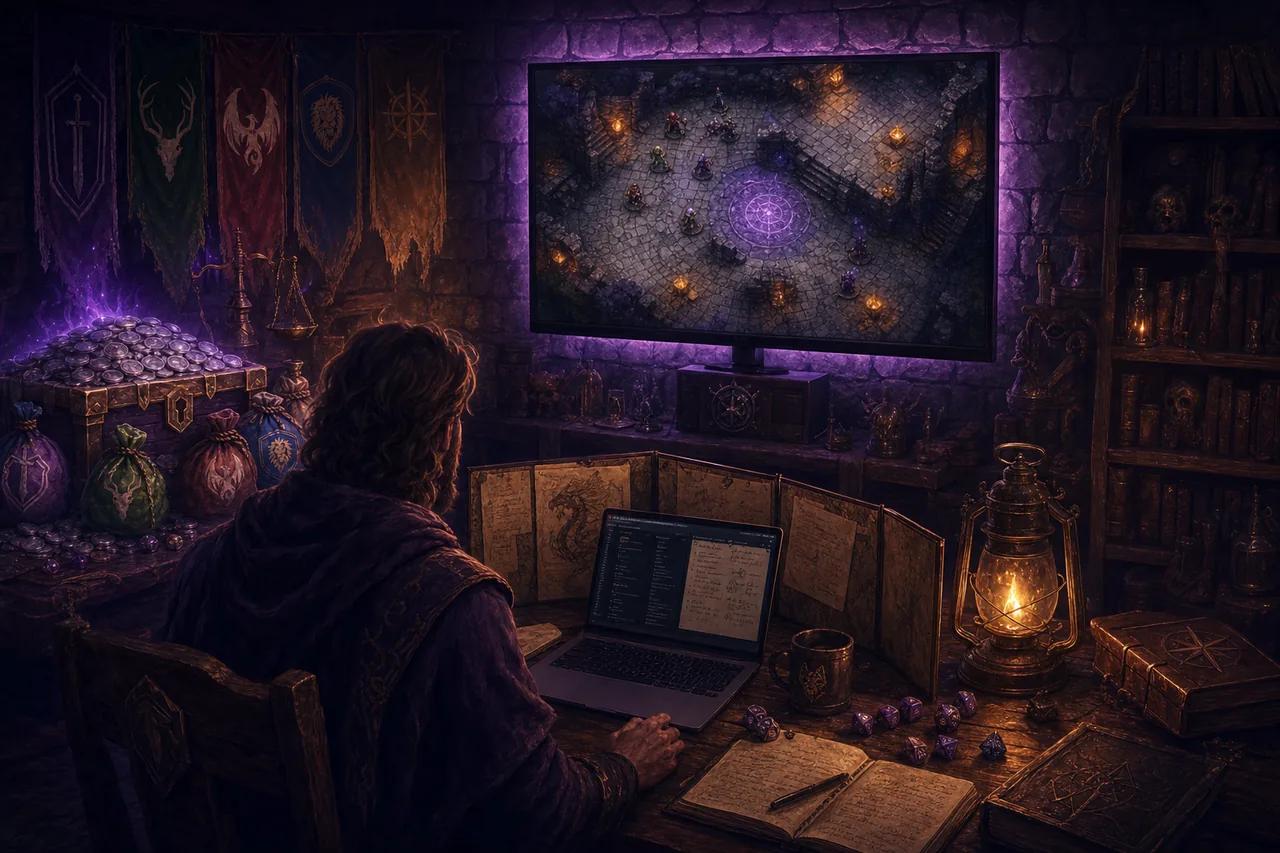
Illustration of a DM working on a laptop behind a folded DM screen while a wall-mounted TV above shows a top-down dungeon battle map

How do I cast to an Apple TV with AirPlay?

What you need

An Apple TV on the same Wi-Fi, and a Mac (see the iPhone / iPad warning below).

Steps (Mac)

  1. Open Control Center → Screen Mirroring and pick your Apple TV.
  2. In System Settings → Displays, change the Apple TV from mirroring to Use as Extended Display — otherwise the table sees your DM screen.
  3. Click Display in the tabletop, move the new tab onto the Apple TV screen, and fullscreen it.

Pros

  • No cable
  • Clean table

Cons

  • A moment of delay compared to a cable
  • Depends on Wi-Fi quality
  • iOS devices can only mirror, not extend

How do I cast to a Chromecast or Google TV?

What you need

A Chromecast or Google Cast-capable smart TV on the same Wi-Fi, and Google Chrome.

Steps

  1. Click Display in the tabletop so the player-display tab exists.
  2. Switch to that tab. In Chrome: menu (⋮) → Cast → Sources → Cast tab → pick the TV.
  3. Fullscreen the tab (F11) so the cast frame is clean. Your DM tab is never sent — only the display tab leaves your machine.

Pros

  • Cheapest wireless option
  • DM screen stays fully private — only one tab is cast
  • Chrome routes that tab’s audio to the TV, which neatly solves the doubled-music problem

Cons

  • Tab casting compresses the picture and caps the frame rate, so fast token movement looks less smooth than HDMI
  • Wi-Fi dependent
  • Chrome only

Can I use a projector instead of a TV?

What you need

Any projector with HDMI (treat it exactly like a TV), or a casting dongle plugged into it.

The steps are identical to the HDMI or Chromecast setups above — the projector is just another extended display. Two mounting styles:

  • Wall projection for a shared vertical view.

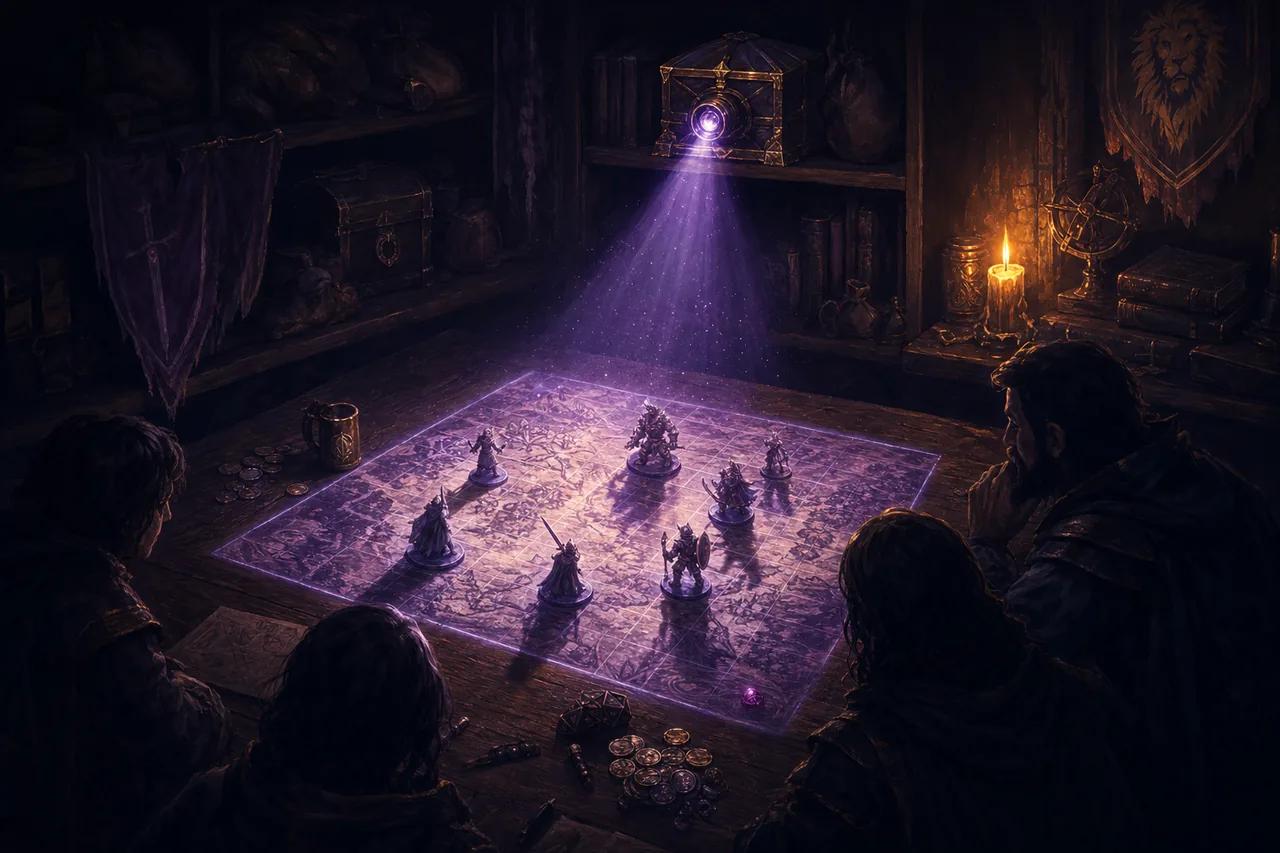
  • Top-down projection onto the table surface so miniatures stand directly on the projected grid. Use the display tab’s zoom controls to size the grid to your miniatures.

Pros

  • The biggest image in the house
  • Top-down projection plus real miniatures is the classic showpiece setup

Cons

  • Needs a dim room — dark dungeon maps wash out under ceiling lights
  • Focus and keystone fiddling
  • Mounting a projector above the table is a project, not a purchase
Illustration of a shelf-mounted projector beaming a glowing battle map down onto a wooden game table, with miniatures standing in the projected light

How do I build a dedicated second monitor or in-table screen?

What you need

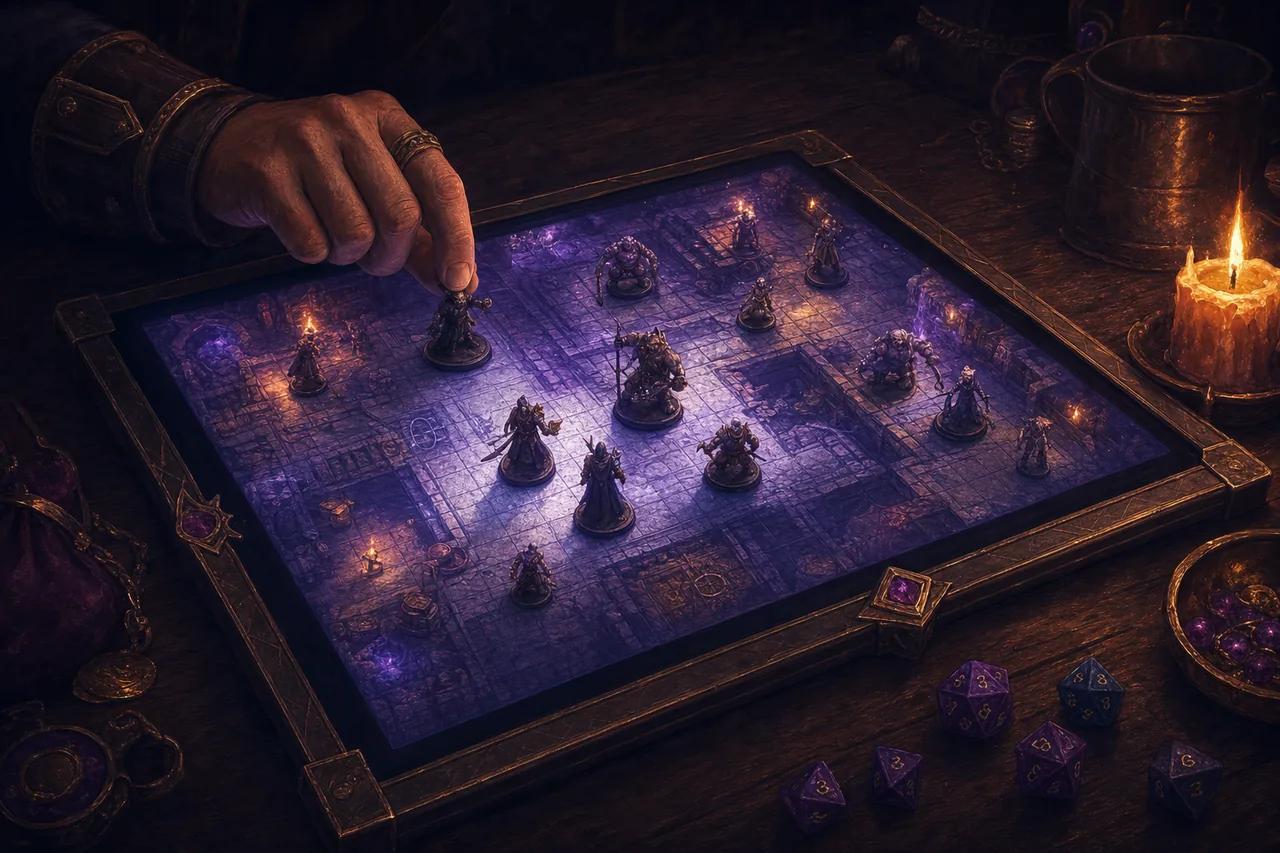
A permanently placed monitor or TV (some groups lay a TV flat in a custom table under acrylic), driven either by your DM laptop over HDMI or by its own cheap device — an old laptop, a mini PC, or a tablet with a browser.

Steps (own device — the nice part)

  1. Sign in to Tavern Scribe on the table device. Any member of the campaign works — it doesn’t have to be your DM account, and a player account is the safer thing to leave signed in at the table.
  2. Browse straight to /campaign/{your-campaign-id}/vtt/display — the same URL the Display button opens. Bookmark it on that device.
  3. Fullscreen it and you’re done: the table screen now runs itself, independent of your DM laptop.

Pros

  • Always ready
  • Survives you closing your laptop
  • No cables to your seat
  • Feels like furniture, not AV setup

Cons

  • Dedicated hardware
  • You must stop the device from sleeping (see troubleshooting)
  • Mostly hands-off: signed in as a player, a touch screen can drag that player’s own tokens, but there are no DM controls
Illustration of a screen lying flat in the game table showing a glowing dungeon map, with a hand moving one of the miniatures standing on the glass

Can players use their phones as character sheets next to the shared screen?

What you need

Nothing extra — the phones already at your table and each player’s existing account.

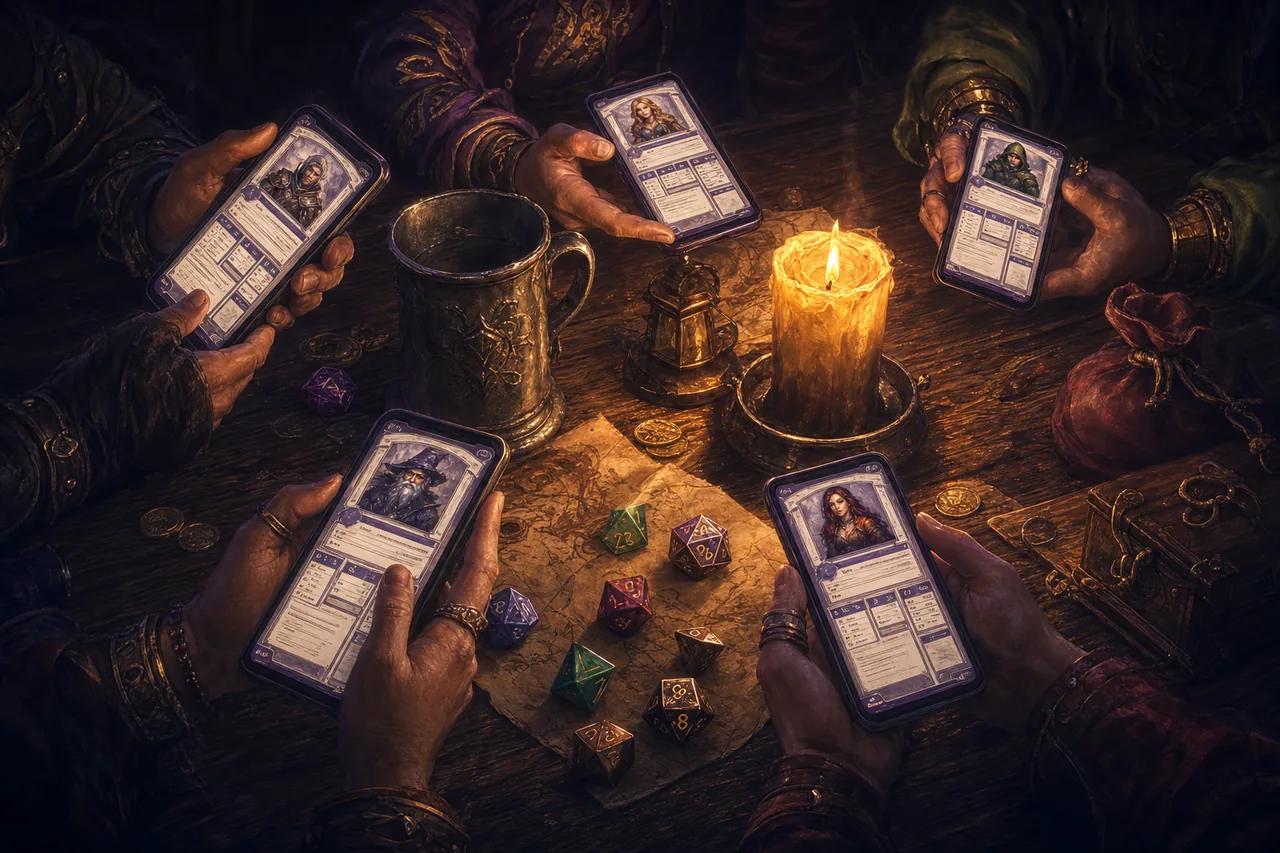
Yes, and it needs zero extra hardware. When a player opens the live tabletop on a phone, it lands on their character sheet first — a phone at the table works as a character terminal, with sheet, dice, and chat one tap apart and the map one tap away behind the hub button.

Steps

  1. Each player signs in on their phone, opens the campaign’s live tabletop, and keeps their sheet up.
  2. Rolls and messages land in the shared party chat — which the table’s TV shows live in the read-only chat panel, so everyone sees the results on the big screen.

Pros

  • Sheets and dice stay in each player’s hands
  • The TV stays a clean map
  • Results are still public on the shared screen

Cons

  • Phone screens are not for map study (the map is one tap away, but the TV is the point)
  • Phones at the table invite phone-at-the-table behavior
  • Battery
Illustration of five hands around a candlelit table, each holding a phone showing a character sheet with a portrait and stat panels

What about remote players or a hybrid table?

What you need

Accounts and campaign invites for the remote players; optionally a webcam pointed at the room.

Here’s the thing a web tabletop buys you: remote players don’t need your screen share. Each remote player signs in and opens the live tabletop in their own browser. They get a real interactive player view — their own vision and fog, their own sheet and dice — synced live with the room, instead of a compressed video of your monitor.

  • Faces and voices The tabletop has built-in voice and video chat, so remote players can see the room and be seen. Using Discord or Zoom for voice instead is completely fine.

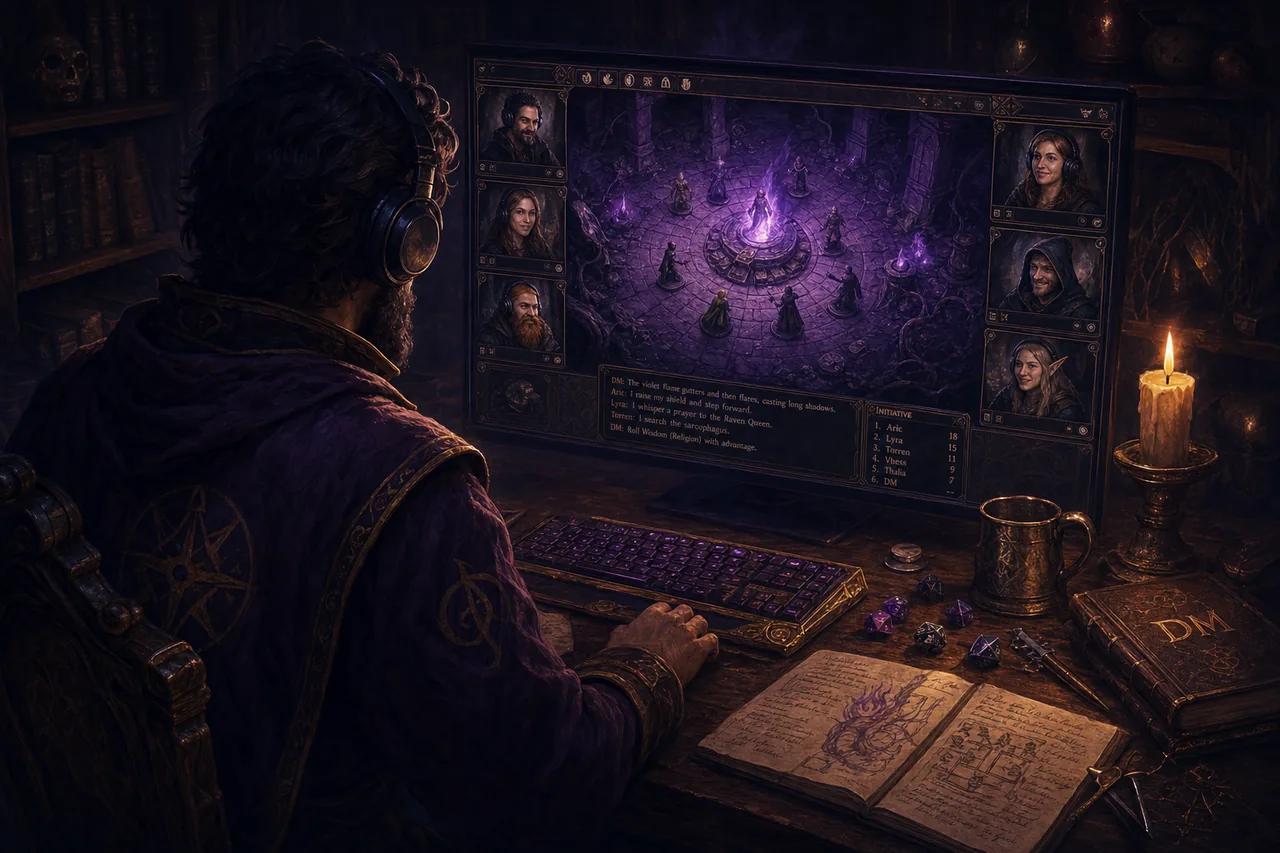
  • Hybrid recipe Table TV running the display tab for the in-person group + remote players in their own browsers + one laptop camera pointed down the table on video chat.

  • Screen share as a fallback If a guest player has no account yet, sharing the display tab (not your DM tab) over Zoom or Discord works — it’s player-filtered, so nothing secret can leak.

Pros

  • Remote players are first-class, not spectators
  • Nothing secret can appear on a shared display tab

Cons

  • Remote players need accounts and campaign invites
  • Video quality is only as good as everyone’s connection
Illustration of a DM wearing headphones at a desk, the monitor showing a battle map ringed by video portraits of five remote party members

When it misbehaves

Troubleshooting.

Eight fixes that cover nearly every table-display problem. Most of them end with “refresh the display tab.”

Looking for pricing, uploads, or account questions? Read the main FAQ.

The TV is showing my DM screen.

The display is mirroring instead of extending. Windows: press Win+P and choose Extend. macOS: System Settings → Displays → Use as Extended Display. Then move only the player-display tab to the TV.

Nothing opened when I clicked Display.

Your browser blocked the pop-up. Allow pop-ups for Tavern Scribe and click Display again — repeat clicks reuse the same display tab instead of stacking new ones.

The TV goes to sleep mid-session.

That’s the computer or TV power settings, not the tabletop. Before the session: set the machine driving the TV to never sleep while plugged in, keep the display tab as the visible foreground window, and turn off the TV’s own eco or idle timer.

The edges of the map are cut off.

TV overscan. In the TV’s picture settings choose “Just Scan”, “Fit”, or “Full pixel”. Then fullscreen the browser (F11) so no tab bar eats into the map, and use the display tab’s zoom controls to frame the fight.

The display froze or stopped updating.

The browser suspended the tab (common after long minimizes). Refresh the display tab — it reconnects to the live session and catches up. Keeping it fullscreen and in the foreground on the TV prevents most suspensions.

Music is playing twice.

The display tab plays session audio too. Drag the master-volume slider in the display tab’s top bar to zero, or mute that tab in your browser — or mute your DM tab and let the TV carry the sound. Tab-casting to a Chromecast sends the tab’s audio to the TV automatically.

Which browser should I use?

Any modern browser for cable setups. For Chromecast you need Chrome, because tab casting is a Chrome feature. For AirPlay use whatever browser you like — AirPlay happens at the OS level.

The TV is on the wrong map.

The display follows the DM’s character: move your character onto a map and the display switches to it. Move everyone here from the maps browser switches it too, along with the whole party. If it ever desyncs, refresh the display tab.

Side by side

Every setup, compared.

Comparison of the seven DM table display setups
SetupExtra hardwareWirelessDelayFussBest for
TV over HDMIHDMI cableNoNoneLowMost tables — start here
Apple TV (AirPlay)Apple TV + MacYesSlightLowApple households
Chromecast (Cast tab)Chromecast + ChromeYesSlightLowCheapest wireless
ProjectorProjector (+ mount)EitherSame as sourceHighBig rooms, minis on the grid
Dedicated table screenMonitor/TV + spare deviceEitherNoneMedium once builtPermanent game rooms
Phones as sheetsNoneNoneEvery in-person table, alongside any of the above
Remote / hybridWebcam (optional)LowSplit or fully online groups

Delay and fuss are honest generalizations of typical AV behavior, not measured figures — your Wi-Fi may vary.

Ready to run it

Bring the battle map to your next in-person session.

The player display is part of the live tabletop, so any campaign you run in Tavern Scribe can go on the table’s TV. See what else the tabletop does, or start a campaign for free.