

TL;DR — Quick Answer
To keep track of NPCs in a long campaign, record five things for every named character the moment they matter — name, role, location, want, and relationship to the party — and store them somewhere searchable, not in your head. A spreadsheet or index cards work if you update them every session; a tool that fills itself in from the recording works even on the weeks you don't.
Looking for the tool rather than the system? See the campaign tracker built to hold exactly this.
By session 20, every long campaign has the same problem: more named NPCs than any one brain can hold. The blacksmith who owes the party a favor. The merchant whose cousin was the bandit. The noble who lied about the letter three sessions ago. None of it is complicated on its own — it's the volume that gets you, and the fact that your players remember the thread and expect you to as well.
Why NPC tracking breaks down in a long campaign
Most DMs start strong. Session one, you remember every name because there are only three of them. By session fifteen there are forty, half of them introduced in a single throwaway line that turned out to matter later. The system that worked at session one — "I'll remember" — doesn't scale, and nothing replaces it until a players asks "wait, didn't she say she'd help us?" and you're guessing.
The fix isn't a better memory. It's writing the right five things down for every NPC, at the moment they first matter, somewhere you'll actually look again.
The five fields worth recording for every NPC
Skip the full character sheet — most NPCs never need one. Record only what you'll actually need later:
- Name and role. Who they are and what they do, in one line ("Harr, the blacksmith").
- Location. Where the party met them, so you can place them again without inventing a new town.
- Want. What they're after. This is the single most useful field — it tells you what they'll do the next time they appear, even if you haven't thought about them in six sessions.
- Fear or leverage. The thing that makes them act against their own interest when pushed. Villains and allies both need one.
- Relationship to the party. Friendly, hostile, owes a debt, holds a grudge — and why.
Five fields, one line each. An NPC who dies in one scene doesn't need all five. An NPC who recurs for ten sessions is worth every one of them.
A copyable NPC tracker template
Steal this. One block per NPC, plain text, works in any notes app:
NAME: Harr
ROLE: Blacksmith, Dunmoor
LOCATION: Dunmoor, the forge on Low Street
WANT: Buy out his rival's shop before winter
FEAR/LEVERAGE: Owes a debt to the party for the goblin raid
RELATIONSHIP: Friendly, will haggle in the party's favor
LAST SEEN: Session 12 — offered free repairs
Add a LAST SEEN line and update it every time the NPC appears. That one field turns a static list into a timeline — scan it before prep and you instantly know who's overdue for a callback.
Track relationships, not just names
A name-only list answers "who is this." It doesn't answer the harder question: "how does this NPC feel about us right now, and why?" That's the field parties actually test — they bribe, threaten, and befriend NPCs specifically to change the answer.
Keep relationships as their own short note, separate from the character description, and update it after any scene that moves the needle. "Friendly, owes a debt" at session 5 might read "neutral, debt repaid, mildly suspicious after the break-in" by session 18. If you only track the name, you lose that arc — and the arc is usually the part your players remember.
How Tavern Scribe automates this from your recordings
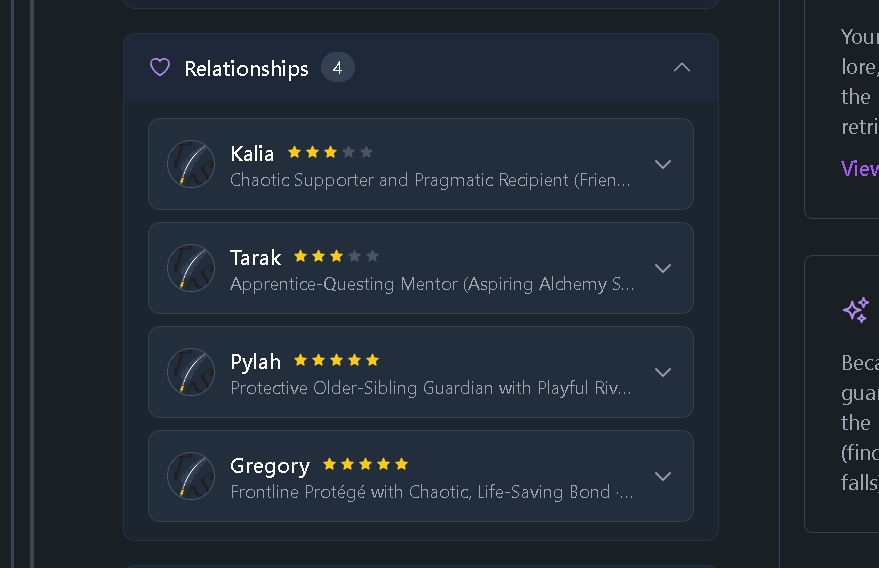
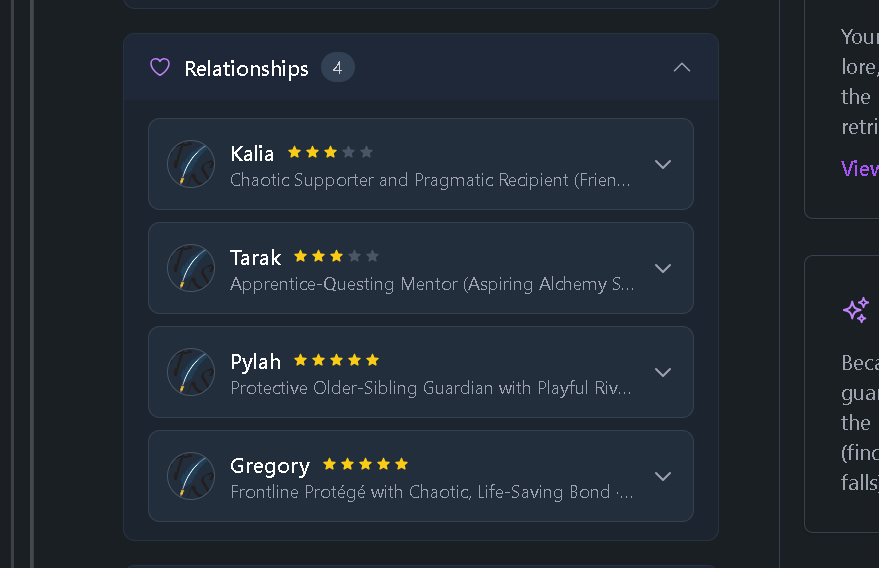
Manual tracking works, but it only works if you update it every session, which is the part that slips. Tavern Scribe's campaign tracker does the same five-field job automatically: it tracks player characters, NPCs, and the fallen, with relationship tracking showing how the party stands with each one — and when the entry comes from a recorded session, it links straight back to the timestamp where it happened, so "what did she actually promise us" is a ten-second clip instead of a guess.
Three ways to get a session into the tracker: play on the free virtual tabletop and record right where you play, add the Tavern Scribe Discord bot to your voice channel and run /record start, or upload any recording — phone audio from an in-person table works fine. Manual entry still works everywhere too; recording is what makes the updates automatic instead of a chore you do (or skip) after the table packs up.
For the workflow this plugs into at the table, see how to prep a D&D session using campaign memory — NPC lookups are one step in that fifteen-minute loop. If your table runs over Discord specifically, here's the recording setup.
Keeping NPCs alive between sessions
A long-running thread like this r/rpg discussion on NPC tracking sheets makes the same point hundreds of DMs have landed on independently: the format matters less than the habit. A few rules that make the habit stick:
- Write the entry the moment the NPC matters, not at the end of the night when you've forgotten half the details.
- Review before prep, not during the session. Scanning your NPC list is a prep-night task; digging for a name mid-combat is the failure mode you're trying to avoid.
- Retire NPCs on purpose. Not every NPC needs forever-tracking. Mark the ones who are genuinely done so your active list stays short enough to actually scan.
- Let players ask. If a player wants to know an NPC's status, that's a free prompt to update your records — don't guess, check.
FAQ
How do I remember NPC names in D&D?
Write the name down the moment you invent it, in a list you'll actually reopen — not a notebook that lives in a bag between sessions. Pair every name with one line on role and want; the context is what makes the name stick, not the name alone.
What's the best way to track NPC relationships?
Keep relationship status as its own field, separate from the character's description, and update it after any scene that changes it — a favor repaid, a lie discovered, a threat made. A list that only has names tells you who exists; a list with relationships tells you what happens next time they show up.
Should every NPC get a full tracking entry?
No. Most NPCs are one-line footnotes who never reappear. Give the full five-field treatment only to NPCs who recur, matter to a quest, or hold a relationship with the party — everyone else can stay a name in a scene description.
Do I need a tool to keep track of NPCs, or does a spreadsheet work?
A spreadsheet or index cards work fine as long as you update them every session — that discipline is the whole system. Tools help with the weeks the discipline slips: Tavern Scribe's campaign tracker fills in NPC and relationship records automatically from a session recording, so the list stays current even when you don't have time to type it up yourself.
Start tonight
Pick your three most recent NPCs and write the five fields for each — ten minutes, and your next session already has fewer "wait, who was that again" moments. Want the version that fills in on its own? Create your free campaign: your first campaign comes with 100 free silver for the AI processing that turns a recorded session into tracked NPCs, relationships, and more.
Drafted with AI by the Tavern Scribe team and reviewed by a person. Last reviewed 2026-11-22.
Tags: Campaign Tracking, Dungeon Master Tips, Session Prep, Dungeons And Dragons, Ttrpg
