

TL;DR — Quick Answer
A session zero is the meeting a table holds before the first real session, and a session zero checklist is the list of decisions to make there: the campaign pitch and tone, what the table is comfortable with, safety tools, the schedule and attendance rule, the edition and house rules, how the characters know each other, and where the answers get written down. Run it in one evening, write the answers somewhere everyone can see, and the campaign is far more likely to reach session twenty.
Want the prep tool rather than the checklist? See session prep with campaign memory. This post is the checklist itself, copyable below.
What is a session zero?
Session zero is a planning session, not a play session. The DM pitches the campaign, the players say what they want out of it, the group agrees on how it will play (rules, tone, safety, schedule), and usually everyone builds characters together so the party makes sense as a group. It is "zero" because the story starts at session one.
Most campaigns that fizzle do not fizzle because of a bad plot. They fizzle because nobody agreed on a night, two players wanted a grim war story and two wanted a heist comedy, or a character died in session three under a rule the player didn't know existed. Session zero is where those collisions get found while they are still cheap.
How long should a session zero take?
Plan 90 minutes to two hours for a new campaign, with character creation taking the second half. For a one-shot, ten minutes at the top of the night covers the essentials: tone, safety tools, and what to expect. For a new player joining a running campaign, do a 20-minute version one on one before the session.
If it runs past two hours, you are discussing instead of deciding. The checklist below is ordered so the quick agreements come first and the slow ones (characters) come last, when the group is already warmed up.
The session zero checklist
Copy this into your campaign notes and fill it in at the table. Each line is a decision, not a topic.
SESSION ZERO CHECKLIST

1. The pitch
   [ ] One-paragraph campaign premise, read aloud
   [ ] Tone and rating (grim / heroic / comedic; PG / PG-13 / R)
   [ ] Expected length (one-shot, short arc, open-ended)
   [ ] Player-facing hooks: what the party is doing on day one

2. The table
   [ ] What each player wants more of (combat, intrigue, exploration, roleplay)
   [ ] What each player wants less of
   [ ] Phones, side chatter, snacks, who hosts

3. Safety
   [ ] Lines (never in the game) and veils (happens off-screen)
   [ ] A pause signal everyone knows (X-card, "pause", a hand gesture)
   [ ] How to raise a problem later, privately

4. Logistics
   [ ] Regular slot: day, start time, hard stop
   [ ] Attendance rule: play with N present? skip? NPC the absent PC?
   [ ] Where you play: in person, online, or hybrid
   [ ] Who records or writes the recap, and where it lives

5. Rules
   [ ] Edition and sourcebooks allowed
   [ ] Optional rules in use (flanking, feats, multiclassing, encumbrance)
   [ ] Character death: how likely, and what happens next
   [ ] Player-vs-player: allowed, limited, or never
   [ ] Loot and gold: who tracks it, how it's split
   [ ] Rolling: open or behind the screen; rerolls; nat 1 on skills

6. Characters, together
   [ ] Each PC answers: why am I here, and why do I stay?
   [ ] At least one tie to another PC
   [ ] One backstory hook the DM is allowed to use
   [ ] Roles covered, or an agreement that gaps are fine

7. Write it down
   [ ] Agreements saved in a shared note the players can open
   [ ] House rules saved as their own note
   [ ] Schedule confirmed with everyone, not just "sounds good"
Two notes on using it. First, let players answer section 2 before you pitch section 5; the house rules should follow what the table wants, not the other way round. Second, section 3 is short on purpose. Safety tools are not a lecture; they are a shared vocabulary, and the TTRPG Safety Toolkit is a good free reference if your table hasn't used them before.
How do you run session zero without it dragging?
Treat it like a meeting with an agenda, because it is one.
- Send the pitch ahead of time. A paragraph in the group chat a few days early means session zero starts with reactions, not a reading.
- Decide, don't discuss. When a topic stalls, the DM proposes a default and asks "any objections?". Silence is a yes. You can revisit anything at session five.
- Write as you go. Whoever is quickest on a keyboard fills in the checklist live. If nobody writes it down, you will have this meeting again in a month.
- Characters last, together. Building the party in the same room is the single best thing session zero does. Two players who built matching backstories at a kitchen table will show up for each other for a year.
- End with the first scene. Spend the last ten minutes on "here's where session one opens". People leave excited instead of administratively satisfied.
Where should the answers live?
The checklist only works if the table can find it later. A screenshot in a group chat is gone in a week.
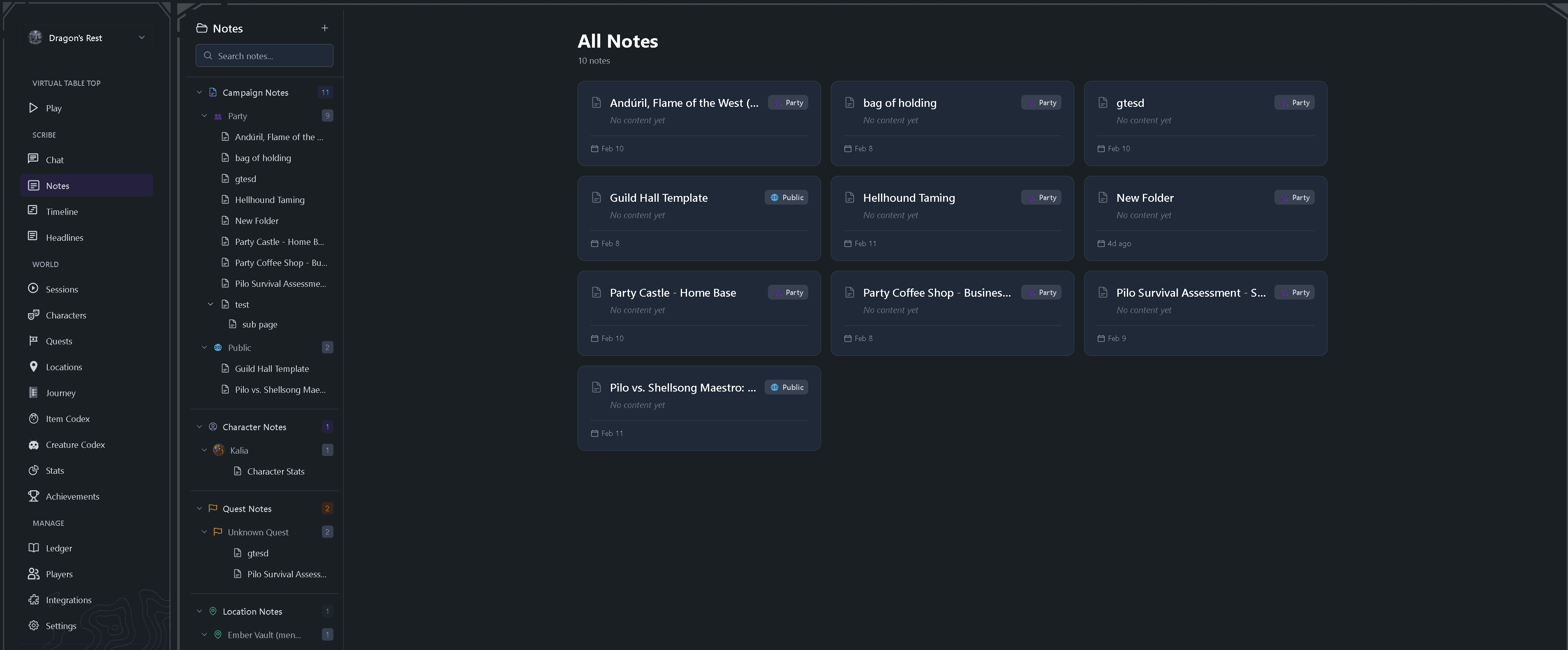
Put the agreements in a shared campaign note that every player can open, and keep house rules as a separate note so they are easy to amend. In Tavern Scribe the campaign has shared notes for exactly this, and the prep page carries a schedule poll so "Tuesdays at seven" is confirmed by everyone rather than assumed. From there the rest of the campaign record builds on the same foundation: the session prep loop starts from last session's recap, and tracking the campaign covers what else is worth writing down as play goes on. If the thing that exhausts you is the admin rather than the prep, this post is about that.
Session zero for a one-shot or a mid-campaign newcomer
For a one-shot, run sections 1, 3 and 5 in ten minutes and skip the rest: pitch and tone, safety tools, and the three rules that matter tonight. Pre-generated characters remove section 6 entirely.
For a player joining an established campaign, give them the existing note (that is the payoff of writing it down), then spend twenty minutes on their character's tie to the party and one backstory hook. Do it before the session, not during; the rest of the table should not sit through a second session zero.
FAQ
What is a session 0 in D&D, in one sentence?
It is the planning meeting before the first session where the group agrees on the campaign's premise, tone, rules, schedule and safety tools, and usually builds characters together.
Should players make their characters at session zero?
Yes, if there is time. Building characters together produces a party with reasons to stay together, which is worth more than any plot hook. If you must build beforehand, still do section 6 at the table so the ties get made.
What if a player skips session zero?
Send them the written checklist and do a 15-minute catch-up before their first session. The written note is the whole reason section 7 exists.
Is session zero the same as session one?
No. Session zero is planning and character creation; session one is the first session of play. Some tables run a short scene at the end of session zero, which is fine, but the story proper begins at session one.
How often should we revisit the agreements?
Check in briefly whenever something changes: a new player, a tone shift in the story, or a rule that caused an argument. A two-minute check at the start of a session is enough; you do not need a second full session zero.
Start free, your first campaign comes with 100 silver for the AI parts: create your campaign.
Drafted with AI by the Tavern Scribe team and reviewed by a person. Last reviewed 2026-11-07.
