

TL;DR — Quick Answer
To DM D&D for the first time you need four things: a short adventure you have read twice, a prepared opening scene, the three rules that will actually come up (ability checks, initiative order, hit points and death saves), and a way to remember what happened. Keep the first session to about two hours, start in the middle of something, say "what do you do?" more than you say anything else, and write down what happened the same night. Everything else you can learn at the table.
Want the prep tool rather than the guide? See session prep with campaign memory. This post is the first-session walkthrough.
What does a DM actually do?
The Dungeon Master describes the world, plays every character the players don't, decides what a rule means when it is unclear, and keeps the game moving. That is the whole job. You are not the players' opponent and you are not a performer who has to be entertaining for four hours; you are the person who answers "what do we see?" and "what happens when I try that?".
Two things new DMs get wrong in opposite directions: over-preparing a plot the players will walk past in ten minutes, and under-preparing the handful of rules that come up every session. The fix for both is the same: prep less story and more structure.
What should you prep before your first session?
If you have not run a session zero, do that first, even a ten-minute version. Then prep these, and nothing else.
- One short adventure. A published starter adventure or a one-page scenario you wrote. Read it twice. You should be able to say what the players' goal is in one sentence.
- The opening scene. Where the characters are, what is happening in front of them, and the first decision they have to make. Write it as three or four sentences you can read aloud.
- Three to five NPCs with one line each. A name, what they want, how they talk. "Marta, innkeeper, wants the road cleared, talks in short sentences." That is enough to play her for an hour.
- One fight, one puzzle or negotiation, one choice. A first session needs a chance to roll dice, a chance to talk, and a moment where the party decides something. It does not need six encounters.
- An ending condition. Know what "we're done for tonight" looks like so you can steer toward it when there are twenty minutes left.
- The three rules. Ability checks and advantage, initiative order, and hit points including death saves. The free basic rules cover all three; put a bookmark on each.
Write all of it on one page. If it does not fit on one page, you are prepping for session three.
How do you open the first session?
Start in motion. "You've been on the road for two days when the caravan stops; the driver is pointing at smoke over the next hill. What do you do?" beats ten minutes of history. The question at the end is the important part: it tells the players the game has started and that their choices are what moves it.
Then:
- Let every player describe their character once before anything happens, in a sentence or two. It gets the shy ones talking early.
- Say yes to small things. A player wants to climb the cart for a better look? Yes, roll Perception. Cheap yeses buy you the right to a firm no later.
- Ask for rolls only when failure is interesting. If nothing happens on a failure, just tell them they succeed.
How do you run combat without it stalling?
Combat is where first sessions die, because six people are waiting on one. The cure is order and speed.
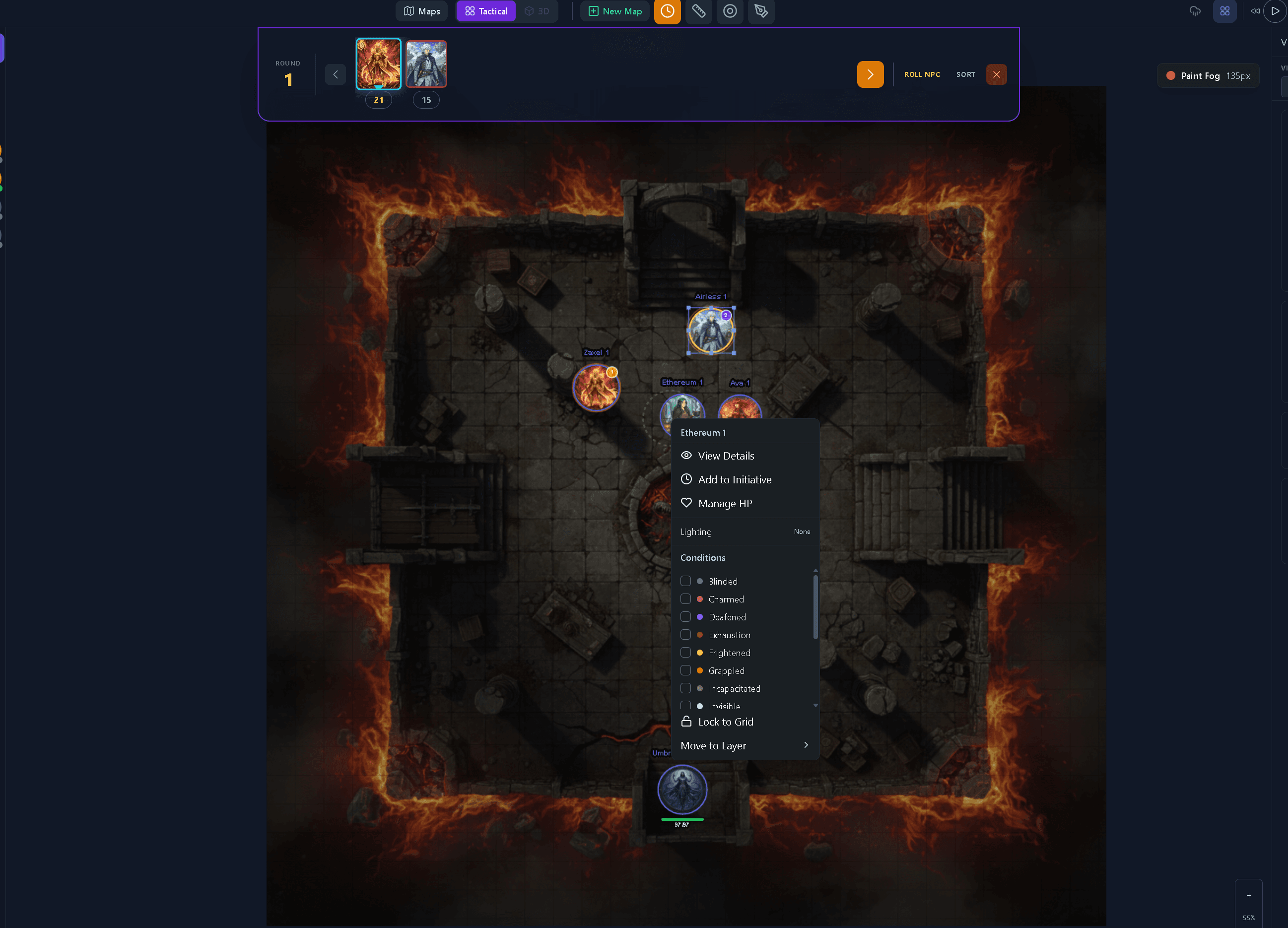
- Roll initiative and write the order down where everyone can see it. On paper, a whiteboard, or the initiative tracker in your virtual tabletop. The Tavern Scribe VTT keeps the order and conditions on screen for the whole table, which removes "whose turn is it?" entirely.
- Describe, roll, resolve, next. Each turn is one sentence of description, one roll, one result. Do not narrate every miss as an epic near-hit.
- Monsters act fast. You already know what they do. Take your turns in ten seconds and the players will speed up to match.
- Call the hit points out loud when it matters. "The wolf looks badly hurt" is enough; players make better decisions when they can read the fight.
- End the fight when it is decided. If the last goblin is at two hit points and the party is at full strength, it runs. Nobody wants round six.
Theater of the mind is fine for a first session; a map helps the moment there are more than three monsters or anyone asks "can I get to him?".
What do you do when the players go off-script?
They will, and it is a good sign: it means they believe the world is real. Three habits make it painless.
- Give the unplanned NPC one motive and play that. A guard who wants to be left alone is instantly playable.
- Borrow from your prep. The fight you wrote for the ruins works just as well on the road. Move it.
- Write the detour down. The names you invent on the spot are now canon, and the players will remember them better than your plot. This is the single biggest reason to keep a record (next section).
If you genuinely have nothing, say so: "Give me two minutes." Players would rather wait than watch you flail, and the pause reads as care, not weakness.
How do you remember everything for session two?
The first session produces more campaign facts than any other: names, places, who the party insulted, what they promised. Most of it is lost by the following Wednesday unless it is written down that night.
The low-tech version: ten minutes after the session, write a paragraph of what happened and a list of open threads. The 15-minute prep loop starts from exactly that paragraph.
The no-effort version: record the session and let the recap write itself. If you play on the Tavern Scribe virtual tabletop, it records the table where you play; on Discord, the Tavern Scribe bot joins the voice channel with /record start. Either way the recording turns into a written recap, a timeline and updated character and quest pages, so session two starts from the record instead of from memory. The details are in how to summarize a session from audio.
Ten first-session mistakes, and the fix for each
- Reading a page of lore aloud. Start with a scene instead.
- Prepping a plot. Prep a situation and let the plot happen.
- Looking up every rule. Decide, note it, check it after the session.
- Rolling for everything. Roll when failure is interesting.
- Letting combat drift. Order on display, ten-second monster turns.
- Playing the NPCs as obstacles. Give each one something they want.
- Punishing creativity with a "no". Say yes to small things.
- Running four hours. Two hours, end on a question.
- Forgetting what happened. Write it down, or record it.
- Apologizing for being new. Nobody at the table is grading you; they came to play.
FAQ
How long should a first D&D session be?
Two hours, three at most. End on a decision or a cliffhanger rather than at the end of your prep. A short session that everyone wants more of is the best possible outcome.
Do I need to know all the rules to DM?
No. Know ability checks, initiative and hit points, keep the free rules bookmarked, and make a fair call on anything else. Say "I'll rule it this way tonight and check later" and the table will be fine with it.
Should I use a published adventure or write my own?
For a first session, published. It gives you a tested structure, maps and monsters, so your attention goes to running the table instead of inventing it. Write your own once you have run three or four sessions and know what your players enjoy.
What if I get a rule wrong?
Fix it next session, tell the players, and move on. If the mistake helped the players, let it stand. If it hurt them, give the benefit back. Consistency matters more than correctness.
Can I DM with only two players?
Yes. Give each player a slightly stronger character or a companion NPC, scale fights down, and lean into roleplay, which small groups do better than large ones.
Start free, your first campaign comes with 100 silver for the AI parts: create your campaign.
Drafted with AI by the Tavern Scribe team and reviewed by a person. Last reviewed 2026-11-07.
