

TL;DR — Quick Answer
The best way to take D&D notes is to split the job: DMs track NPCs, open threads, and promises made to the party, while players track what their character knows, found, and owes. Write one running line during natural pauses, not mid-scene, then do a five-minute recap pass right after the table breaks. If nobody at your table wants to stop and write, turning a session recording into notes automatically solves the problem for good.
Looking for the tool rather than the method? See the AI notetaker for TTRPG sessions that generates these notes from a recording.
Most D&D notes fail for the same reason: one person decides to "take notes this time," writes a page of prose during session three, and never opens the document again. By session twelve nobody can say which merchant the party threatened or whether the baron is still alive. The fix isn't trying harder. It's writing less, in the right place, at the right moment.
What should you actually write down during a session?
Less than you think. A running line per beat, not a transcript.
If you're DMing, you're tracking campaign state — the facts the world needs to stay consistent:
- NPCs the party met or changed their opinion of, and why
- Threads opened, closed, or left dangling on purpose
- Promises made to the party (and by the party)
- Loot given, so nothing doubles up next session
- Any ruling you improvised, so you can stay consistent with it later
If you're a player, you're tracking character state — what your character knows, wants, and is owed, which is a different list than the DM's:
- Things your character learned that you, the player, shouldn't act on until your character would
- Promises your character made
- Downtime goals for next session
- Questions you want to ask the DM before the next scene starts
How are DM notes different from player notes?
A DM's notes are the source of truth for the world. A player's notes are a single point of view on it — useful, but not authoritative, and not meant to carry the whole campaign's memory. That split matters because it's where most campaigns lose consistency: the DM forgets a promise because it only lived in one player's head, or a player plays knowledge their character never actually had. A shared session recap, written or generated after the fact, is what reconciles the two — see how to write a D&D session recap if you're building that habit by hand.
A copyable session notes template
Use this during the session — one line per field is enough:
SESSION ## — [date]
Where we left off:
NPCs met or changed:
Quests opened / closed:
Loot & promises:
Lines worth remembering:
Open questions for next session:
Fill it in live, in natural pauses — after combat, at a rest, when the scene changes — not while someone's mid-sentence. The five minutes right after the table breaks is when you expand shorthand into something you'll still understand in three weeks.
Should you write notes during the session or after?
Both, but they're different jobs. During the session, you're capturing facts before you forget them — names, numbers, decisions. After the session, while it's still fresh, you're turning that shorthand into something searchable: what changed, what's still open, what to prep next. Skipping the after-pass is why most D&D notes rot — a pile of session-day shorthand nobody can parse by session twenty. That after-pass is also most of what a proper session prep workflow depends on: prep starts from last session's recap, not from a blank page.
How do you keep notes organized across a long campaign?
A single notes doc that grows forever is how campaigns end up with a 40-page Google Doc nobody searches. A thread on r/DnD asking how people actually take D&D notes turned up dozens of different personal systems — bullet journals, spreadsheets, sticky notes, dedicated apps — and the one thing every working system had in common wasn't the tool, it was that notes were split by type (NPCs, quests, locations) instead of dumped chronologically. If you're choosing a tool for that split, our comparison of D&D session notes apps covers the free and paid options honestly, ours included.
What if nobody wants to stop and take notes at all?
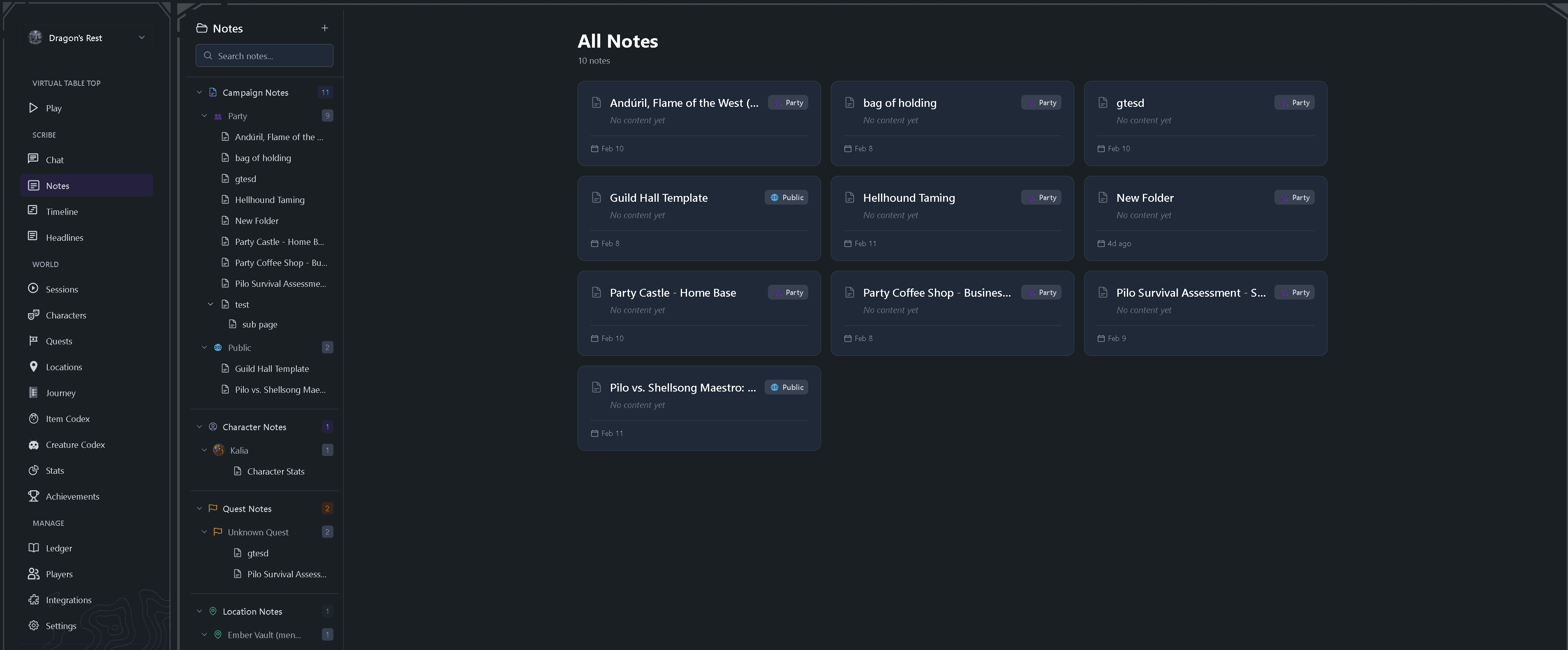
Then don't make anyone. Record the session instead, and let the notes write themselves afterward. Tavern Scribe can generate structured session notes — characters and NPCs, quests and objectives, loot and inventory, dice rolls, and a campaign history searchable by event, linked back to the exact timestamp in the recording — from any session recording. Three ways to capture it: record right on the free Tavern Scribe virtual tabletop while you play, add the Tavern Scribe Discord bot to your server and run /record start in your voice channel (recording settings are per-campaign), or upload whatever audio or video file your table already records. The free Tavern Guest tier covers the campaign workspace and shared notes pages for worldbuilding or personal notes; AI processing runs on silver, and your first campaign starts with 100 free silver, no card required.
FAQ
How do I take D&D notes without stopping the game?
Write one short line per beat instead of full sentences — an NPC name, a decision, a number — and expand it into real notes in the five minutes after the session ends, while you still remember the context behind the shorthand.
What should go in DM notes versus player notes?
DM notes track the world: NPCs, open threads, promises, loot given, and any ruling made on the fly. Player notes track one character's point of view: what they know, want, and owe. Keep both — a shared recap is what reconciles them.
How do you organize D&D notes across a long campaign?
Split by type instead of writing chronologically — separate running lists for NPCs, quests, locations, and loot beat a single long document, because a single document only gets longer and harder to search as the campaign goes on.
How do you format DM notes so you can actually read them later?
Keep the session-day version short and structured (a template like the one above works), then rewrite it into full sentences the same day or the next, before the shorthand goes cold. Notes written three sessions late are rarely usable.
Is it worth using an app instead of a notebook?
Depends on your table. A notebook is fast and free and works fine for a short campaign. A searchable app pays off once a campaign runs long enough that "which session was that in?" becomes a real question — which for most ongoing D&D campaigns is sooner than people expect.
Start free — your first campaign comes with 100 free silver for the AI parts: create your campaign.
Drafted with AI by the Tavern Scribe team and reviewed by a person. Last reviewed 2026-11-17.
Tags: Session Notes, Session Prep, Dungeon Master Tips, Dnd Tools, Ttrpg
